Jenůfa was performed at the Göteborg Opera in 2026. This text is one of several from the performance programme.
The ending! The ending is out of this world!
“In my view, Leoš Janáček is one of the greatest opera composers of the twentieth century, alongside Puccini and Strauss. Janáček’s music has everything – I experience him as profoundly original. There are very few composers whose music you can recognise after just two seconds, if you’re hearing a piece for the very first time. Janáček has such a distinctive way of shaping melody through specific intervals, which is evident in both his harmonic language and his orchestration.
Like Mozart and Verdi, Janáček is always in the service of the drama – he consistently provides the best possible accompaniment to the development of the characters. His treatment of drama fascinates me – his characters are not fixed archetypes but fluid in their behaviour, reactions, and emotions.
Jenůfa was composed during the first decade of the twentieth century – a golden decade in music history, if you ask me. So much was happening and evolving in every possible direction. This is the period when Freud’s psychoanalytic theories were born, influencing both the arts and society at large. At the same time, female characters begin to find their strongest expression.
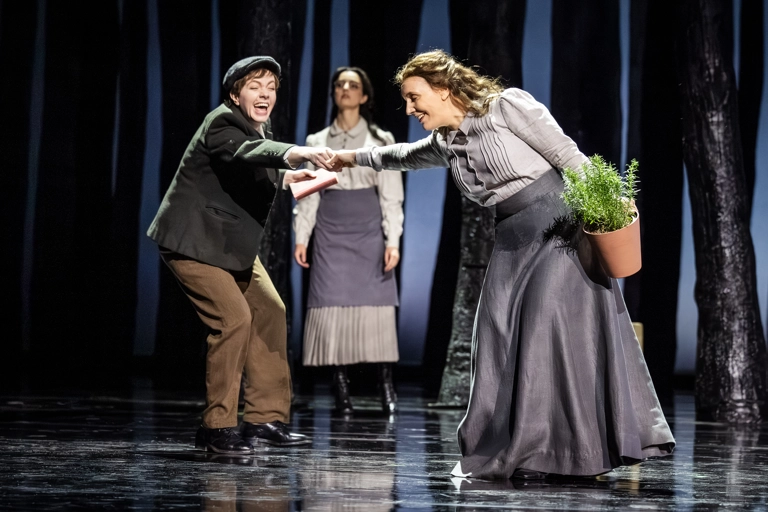
Jenůfa (2026). Ellen Larsson (Jano), Stella Chatzidaki (Barena), Julia Sporsén (Jenůfa). Photo: Håkan Larsson
Jenůfa’s libretto is based on a play by Gabriela Preissová. A contemporary of hers was Marie Pappenheim, who wrote the libretto for Schoenberg’s Erwartung. Janáček’s dramaturgical and musical treatment of female characters in Jenůfa is deeply compelling. It would be misleading to say that they are given the best music – because all the music in Jenůfa is beautiful – but they unquestionably have the most emotionally nuanced scenes.
Playing Janáček’s music is like jumping onto a train that is moving at full speed, with no chance to get off. It has such a powerful forward drive. Janáček provides the continuity: one moment leads quite naturally into the next – he never writes self-contained numbers or “showstoppers.” Jenůfa is one of the first operas written in prose rather than verse, which contributes to this dreamlike continuity.
Janáček’s music is intimately bound to the Czech language. I am by no means fluent in Czech, but I speak some Russian, which has helped me sense how closely his music reflects the language. In Janáček’s music, rhythm often gives the impression of being free, following the natural melody of speech, with rubati (rhythmic manipulation) where the tempo is momentarily stretched or compressed in order to mirror speech – including a strong stress on the first syllable. To achieve the correct rhythm with the orchestra, I often ask the musicians to really listen to the words, to listen to how phrases are spoken in order to understand the natural phrasing and emphases in the music.
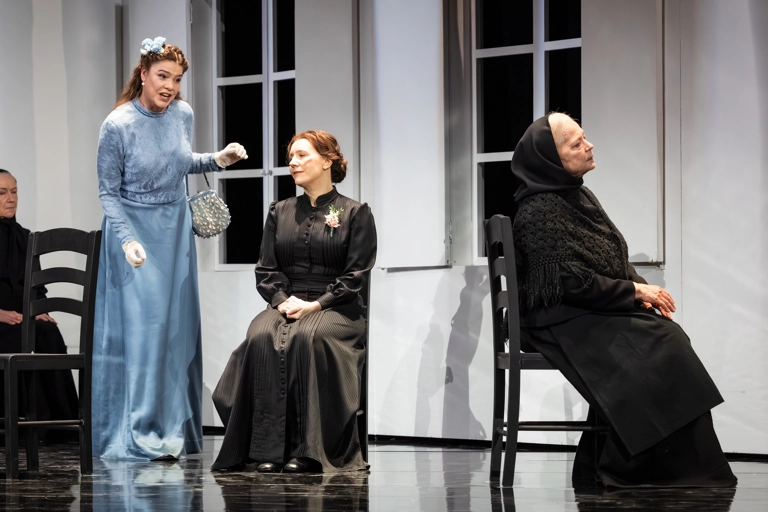
Jenůfa (2026). Ann-Kristin Jones (Karolka), Julia Sporsén (Jenůfa), Ingrid Tobiasson (Grandmother Buryjovka). Photo: Håkan Larsson
For the audience, it can be fascinating to notice how the musical motifs develop. They may begin as a kind of ostinato, a repeated pattern, then suddenly we find ourselves somewhere else without any clear transition. It’s like discovering that you’re in a new chapter without having noticed that you turned the page. These transitions are executed with extraordinary skill by Janáček. There is a kind of subtle movement beneath the surface, where patterns are introduced in order to provide the structure for the next section or scene – but they are very well hidden. What may initially seem like mere accompaniment is already hinting at the mood to come.
Every single note in Jenůfa is beautiful. If I had to choose a favourite moment, it would be Kostelnička’s aria in the second act. And the ending! The ending is out of this world. That transcendent moment in the music where hope rises beyond the tragedy – it’s utterly breathtaking, and something we truly need today, given the state of the world. The feeling that there is hope, despite everything.”
— As told to Lisa Iverstam, programme editor
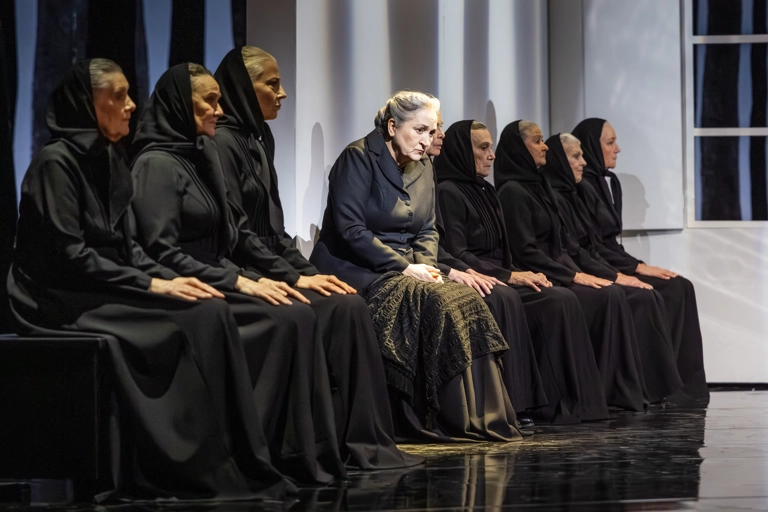
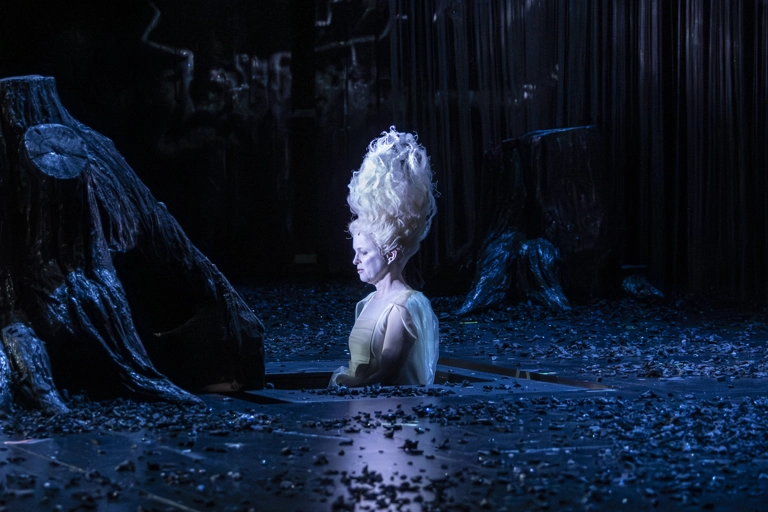
Jenůfa (2026). Katarina Karnéus (Kostelnička Buryjovka). Photo: Håkan Larsson