Back after a century
By Göran Gademan, dramaturge
Der Freischütz was an immediate success when it premiered in Berlin in 1821. The opera spread across Europe and soon reached Sweden. As early as 1823, it was staged at the Royal Swedish Opera in Stockholm. In 1831, a visiting company performed it at the Segerlindska Theatre on Södra Hamngatan in Gothenburg, and the following year it reached Malmö.
The role of Agathe soon became iconic. Two of Sweden’s great sopranos, Jenny Lind and Birgit Nilsson, made their debuts in the role – both stepping in as replacements in performances that proved to be major breakthroughs.
Jenny Lind made her debut in Stockholm in 1838, in the original production, which still featured sets designed by Carl Johan Hjelm. By then, Der Freischütz had been in the repertoire for fifteen years and had been performed almost a hundred times. For a period, it was the most frequently performed opera at the Royal Swedish Opera.
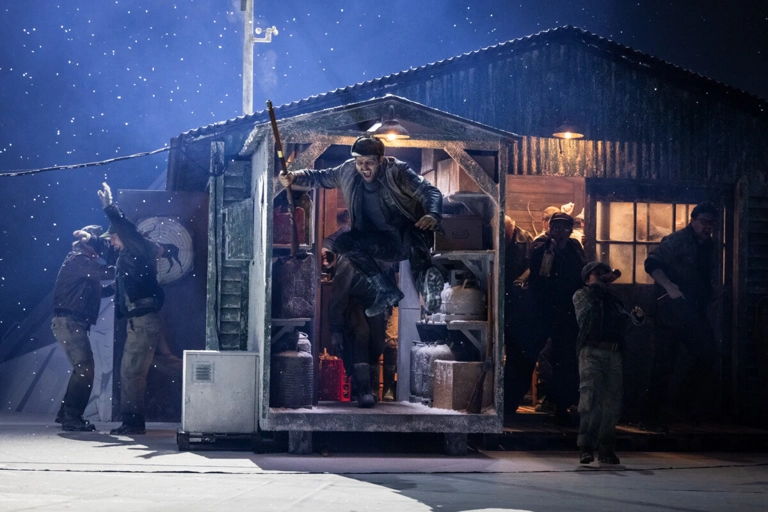
Der Freischütz (2025). Photo: Håkan Larsson
When Birgit Nilsson made her debut as Agathe in 1946, it was in the Opera’s sixth Swedish production, with new sets designed by Bo Beskow. Over the years, set designs had been created by artists including G. A. Müller (1841), Emil Roberg (1857), Carl Grabow (1900) and Thorolf Jansson (1924).
In Gothenburg, Der Freischütz was performed less frequently, but between 1831 and 1891 it appeared in seven different visiting productions, some of which were performed twice. When Stora Teatern opened in 1859, the opera gained a more fittingly grand setting, although the orchestra pit was rather small.
In 1920, Göteborgs Lyriska Teater was founded – the city’s first permanent opera institution, with its own ensemble, chorus, orchestra and administration. And there, almost twenty years before Birgit Nilsson’s Stockholm debut, another sensational Agathe debut took place.
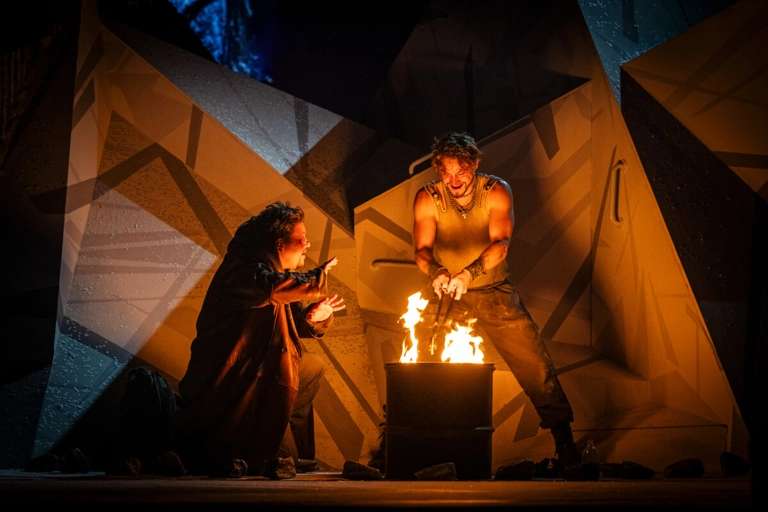
Der Freischütz (2025). Adam Frandsen (Max), Kristian Lindroos (Kaspar). Photo: Håkan Larsson
The opera director Karl Kinch, was an innovative leader who frequently collaborated with the Danish set designer and director Poul Kanneworff. When the time came to stage Der Freischütz in 1928, Kinch had another ace up his sleeve: the Norwegian soprano Kirsten Flagstad made her debut in the role of Agathe. It was an immediate sensation, not only for Flagstad but for the entire production. It received more performances than any other production under Kinch’s leadership, a record that stood for many years.
Flagstad remained in Gothenburg for another two years and returned for three guest appearances before achieving international fame as a Wagnerian soprano. Kanneworff’s evocative sets also attracted considerable attention. The other roles were sung by Conrad Arnesen (Max), Ingalill Söderman (Ännchen), Eric Åby (Kaspar) and Karl Kinch himself as Ottokar. Matti Rubinstein conducted.
Almost a hundred years have passed since Der Freischütz was last staged in Gothenburg. The work was, however, performed in concert at the Concert Hall in 1977 by the ensemble and orchestra of Stora Teatern, during Folke Abenius’s tenure as director. Three concert performances were given, conducted by Leif Segerstam, with Christina Gorne (Agathe), Sten Sjöstedt (Max), Monica Ivan (Ännchen) and Rune Zetterström (Kaspar) in the principal roles.
At the Royal Swedish Opera, Der Freischütz has not been performed since Birgit Nilsson’s debut. She gave three performances as Agathe before later recording the opera for EMI, with Nicolai Gedda as Max.
Incidentally, Der Freischütz is one of the most frequently recorded operas on CD, with recordings dating from the 1950s to the present day. The most recent features Kirsten Flagstad’s successor, Lise Davidsen, as Agathe.
In more recent times, Der Freischütz has been staged in Sweden at Norrlandsoperan (1979), in a highly acclaimed production directed by Torbjörn Lillieqvist, and most recently at Folkoperan in 2008, directed by Linus Fellbom.
One might wonder why such a beloved work has been performed so rarely over the past half-century. Is it too naïve? Too nationalistic? Too German? Has no one dared to take up the mantle after Birgit Nilsson?
Der Freischütz is not confined to Germany. In Denmark, the opera has been staged at Det Kongelige Teater under Weber’s alternative title Jægerbruden, both in 1997 and 2015 – with two Swedish sopranos as Agathe: Hillevi Martinpelto and Gisela Stille. In fact, many Swedish sopranos have enjoyed international careers singing Agathe: Catarina Ligendza, Helena Döse, Nina Stemme, Gunnel Bohman, Erika Roos and Maria Bengtsson are just a few examples. Perhaps European opera houses have been looking for an Agathe with Nordic clarity and strength, rather than the dreamy victim she can so easily become. In 2025 Matilda Sterby takes on the role, and it would hardly be surprising if she were soon singing Agathe internationally as well.
In Sweden, it may be a long time before the next opportunity comes along.
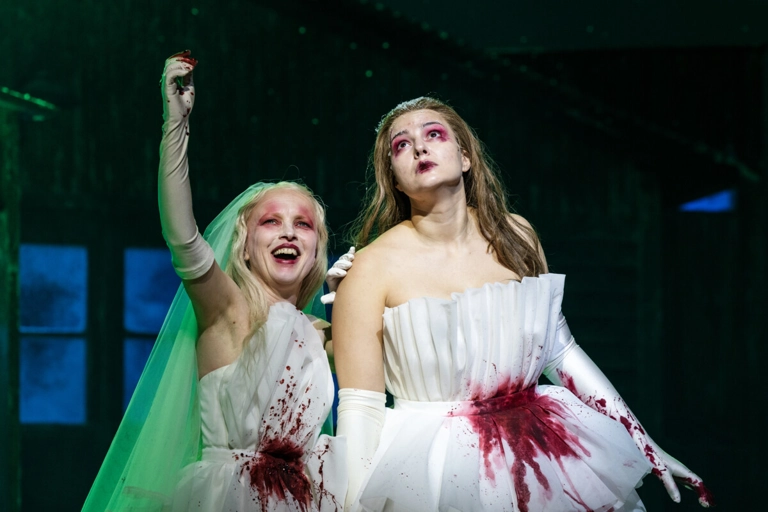
Der Freischütz (2025). Kerstin Avemo (Ännchen), Matilda Sterby (Agathe). Photo: Håkan Larsson