After an evening conducting Wagner, Evan Rogister finds it difficult to sleep. Wagner’s music gets under one’s skin. Yet, once you have embraced it, they want to experience it again and again.
”Richard Wagner broke with the traditional method of composing opera and was the first to employ leitmotifs – musical themes representing emotions, states of mind, events, or people. The Ring Cycle can be viewed, in a sense, as a four-part symphony, with each part further subdivided into smaller sections. Das Rheingold, for instance, contains four major scenes, each with a distinct character and featuring recurring leitmotifs. Wagner might, for example, introduce a theme associated with water early in an opera, where the music ebbs, flows, and surges; he then weaves that same leitmotif into a later scene with an entirely different musical character. In doing so, he reminds the listener of earlier events. While this often goes unnoticed, the listener nonetheless makes the connection on an unconscious level. It is clear that Wagner was deeply interested in the subconscious – and obsessed with philosophers such as Schopenhauer and Hegel.

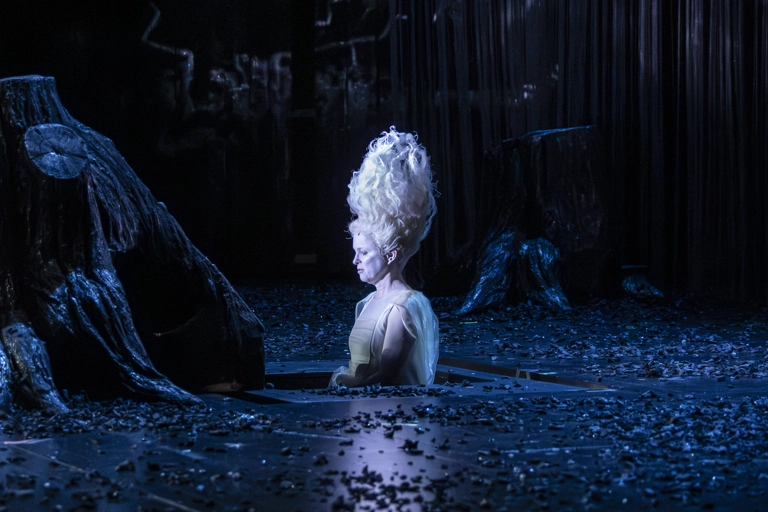
Das Rheingold (2018). In the image: Anders Lorentzson. Photo: Mats Bäcker.
Conducting an art form as traditional as opera is requires engaging with and drawing upon existing knowledge, history, and tradition. As a conductor, I need to be aware of how others have approached a piece before deciding on my own interpretation. To disregard this accumulated body of knowledge would be naive. No two venues are alike – I must always take into account the size of the space, the specific singers involved, and the sound of the orchestra. Tempo, too, is unique to every situation and every venue. A relatively brisk tempo that works at the Göteborg Opera, for instance, might not be suitable for the Metropolitan Opera. In a larger auditorium, the pace needs to be slightly more measured, and the sound requires a bit more breadth. This is something one learns—both through one’s own conducting experience and by listening to others.
I’ve had the privilege of working with the German musician and conductor Richard Trimborn. Among his various roles, he served as orchestra manager at the Bavarian State Opera, but, most notably, he was the best friend and musical assistant to the conductor Carlos Kleiber.
They worked together on the legendary Kleiber recordings, among other things. Sadly, Trimborn passed away in the fall of 2017. However, for several years I traveled to Munich to prepare scores with him. His scores are filled with annotations regarding how various pieces should be performed in different venues – a wealth of knowledge he shared with great generosity.
For Der Ring des Nibelungen at the Göteborg Opera, we’ve chosen to use a critical edition of the score. Wagner is generally very clear about how he wants his music to be performed; this edition includes notes on tempo, dynamics, and expression that Wagner shared with the singers during the original 1876 productions.
Every time I conduct a Wagner opera, I find myself unable to sleep for 24 hours – I’m just too wound up. Wagner’s music gets under your skin. It takes a bit of patience to get to know his music, but once you grasp its profound depths, you want to experience it again and again. I believe this is why people travel across the globe to attend Wagner’s operas.
Wagner held abhorrent views, yet he created magnificent music. I try to adopt the perspective of conductor and pianist Daniel Barenboim, who, when making the controversial decision to stage Wagner in Israel, remarked: “I know Wagner held terrible views, but this is extraordinary art.”
For me, as a conductor, the greatest challenge with Wagner is time. Das Rheingold – lasting a good two and a half hours without an interval – is the longest work a conductor has to lead from the podium. While Wagner’s later operas are longer, no other opera or symphony runs for so long without a break. It is truly a marathon, both for those of us in the orchestra pit and for those on stage.
I knew I wanted to be a conductor as early as age four. After seeing a film clip of Leonard Bernstein, I was hooked. I would play my favorite records over and over, standing in front of the fireplace and waving my arms in time with the music.
My grandmother – an opera singer, vocal coach, and pianist – encouraged me. Afternoons in her house were filled with music. Eventually, she became my first music teacher. She loved and was deeply passionate about the creation of truly great music. She held incredibly high standards, and that took deep root within me.