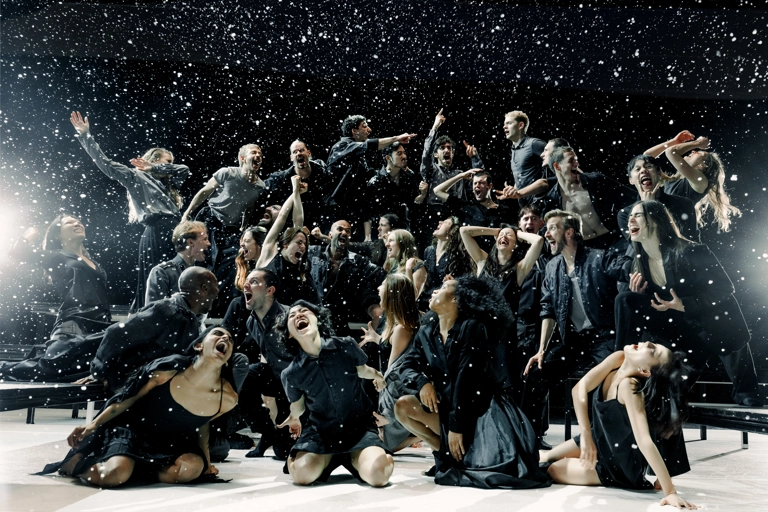
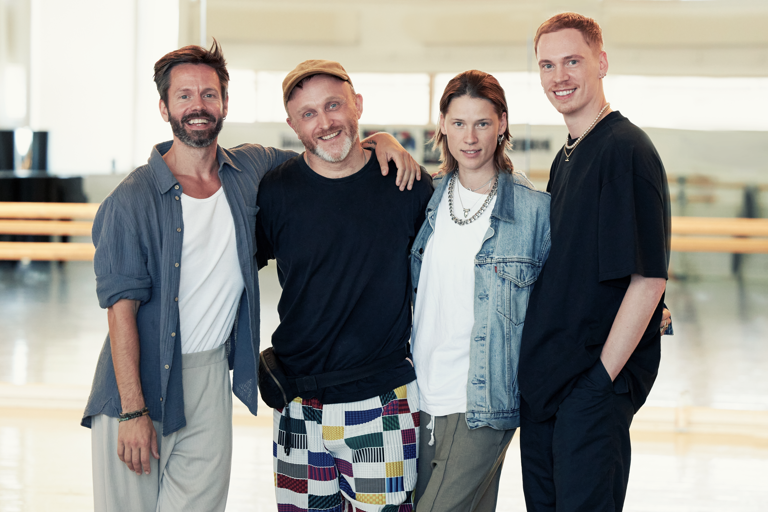
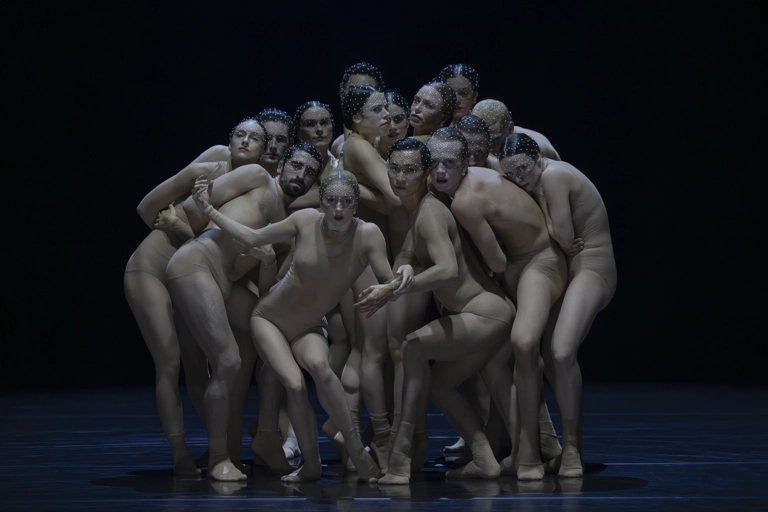
Johanna Wernmo is a dancer with an eye for detail. During her work with Dust and Disquiet, she has asked herself whether destructiveness and affirmation of life can exist as parallel forces.
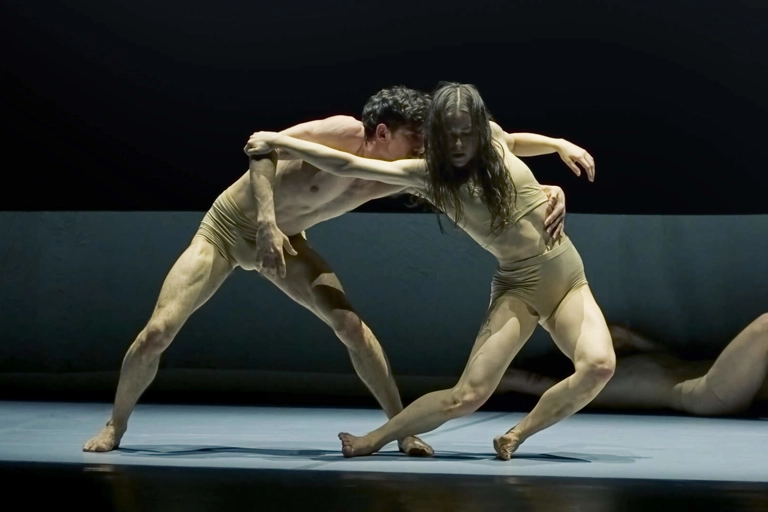
Image from Dust and Disquiet (2022). In the image: Giovanni D’Agati, Johanna Wernmo. Photo: Lennart Sjöberg.
Why did you choose dance?
Every day I find new reasons to dance. In dance, there is space for so many of my interests. For me, the magic is in the studio. Standing on a stage has never been my drive, but of course it is special to be part of the energy of a shared experience with the audience. It has probably been a lot about curiosity and a desire to get as close to an idea, principle or an interaction between anatomy and physics as possible, to continue to be open and attentive. It’s the same when I look at dance and performing arts in general – I want to be close, almost be able to feel for myself what the practitioners’ work does to them, see every fiber of their bodies as they disappear into the task. I love seeing how different people solve things. What paths movements or experiences take in their bodies.
What’s it like working with Johan Inger?
Great fun! He has a lot of experience both as a dancer and choreographer, so he understands things very quickly. It makes it easy to work, it’s high-spirited and very enjoyable, you dare to try things, be open and have fun while being inspired to work hard. Johan has his plan, his framework and his ideas, the dancers fill in and provide input.
Describe the process.
It starts with a search. We’re looking for the different bones of the skeleton that will eventually take on the rest of the body. You don’t know what it will look like when you only have the pieces, but then, when the muscles are added and you get a face, a facial expression, it’s time to fine-tune.
Were there any particular challenges?
One challenge was finding a way to work with the small stage area available at the beginning of the piece. At the same time, it gave certain guidelines: there are fabrics that fall away, one by one, and widen the space. They reveal stones, which look like they’ve been left on a beach. It’s a beautiful image, but at the stones can also be perceived as an obstacle. They can’t be moved, they’re where they are, and that’s perhaps also reflected in the relationship between us as dancers. We start in a kind of embryo. We need each other, physically, to be able to stand up, but then the relationships become increasingly complex. There’s an interplay between dark and light where dysfunction slowly creeps in and leads to a kind of collapse.
Do you experience it as a dystopian work?
In one way yes, but at the same time not really. As I see it, it is about life cycles, both on a macro and micro level. As if the beginning of the piece is not really a beginning but the end of something that then starts over. Life finds a way, there is always a movement that starts something.
In addition, there is no shortage of expressions of how nice it is to be present and see each other. The excitement in the piece is in how you function as a body and makes your way, maybe driven by curiosity and the search for a connection. But in all relationships there is also a darkness. We can see our society that way, as functional and dysfunctional at the same time, and I think it is exciting to work with such paradoxes. It gives depth to the whole thing. Is it light or dark? Can it be both? Can destruction and celebration exist at the same time?
Your way of telling the story sheds light on the title of the work: Dust and Disquiet.
Yes, dust makes me think of something that has happened and how the dust has settled over it. Disquiet is what grows underneath. It never really gets quiet.